CURRENTBODY
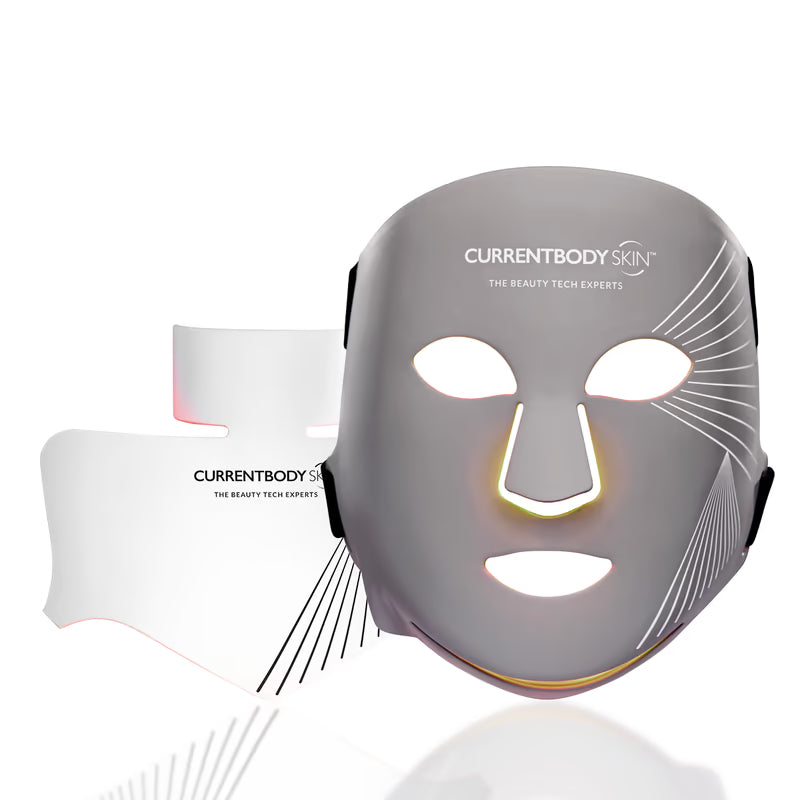
LED Multi Light Therapy Mask
FDA cleared multi-light LED mask with 6 clinically proven LED wavelengths
Couldn't load pickup availability
What you need to know:
- 6 clinically proven LED wavelengths provide red, near-infrared, deep near-infrared, blue, yellow and green light therapy
- 5 treatment modes for advanced skin brightening, clearing and anti-aging
- LED facial mapping technology
- Best-Fit liquid silicone shape
- New LED screen controller with timer and charging indicator
- FDA-Cleared
- Veritace® guarantee ensures the highest level of testing for maximum results. Learn more here
How to choose the best LED face mask?
When it comes to LED light therapy, more power doesn't always mean better results. Effective treatment depends on a precise balance of:
- Wavelength accuracy: reaching the exact skin depth needed to achieve results.
- Coverage consistency: Ensuring light reaches the full treatment area evenly.
- Power: Balanced over time for effective treatments without irritating the skin.
- LED quality: Emitting the correct wavelength at the same strength, every time.
Our devices are designed with all of these factors in mind. CurrentBody is the first brand to test every bulb in every device through Veritace®, guaranteeing that each device delivers the clinical-grade wavelengths proven to work.

LED Multi-Light Mask before and afters
-
Calms redness
Amanda, 5x a week for 6 weeks CurrentBody Verified Buyer
"I’m already seeing a difference. I had patches of red skin and some red scarring that is completely gone now."
-
Evens skin tone
M, 3x a week for 6 weeks CurrentBody Verified Buyer
"My overall complexion looks brighter, my skin texture feels smoother, and my blemishes have become less noticeable." -
Evens skin tone
Ire S, 5x a week for 4 weeks CurrentBody Verified Buyer
"My skin tone is more even, my skin feels supple and looks dewy."
CurrentBody Clinical Evidence
-
SGS ClinicalEfficacy Testing
Tested Veritace@-tested LEDs (633nm/830nm /1072nm) across 35 adults over56 days. Significant measured improvements in wrinkles, hydration,firmness and skin tone.
-
Efficacy StudyEurofins Dermatological
Assessed Veritace@-tested LEDs (633nm/830nm /1072nm) under dermatologicalcontrol across 31 subjects over 56 days.Statistically significant improvements inwrinkles, elasticity,hydration and skin
texture across face, neck and chest. -
University of ManchesterPhotoageing Study
University-led investigation into
Veritace@-tested LEDs (633nm/830nm/1072nm) and photoageing reversal. 20+participants over 12 weeks, including clinical assessment and skin biopsies. -
Eurofins WavelengthEfficacy Study
Series of three 8-week clinical studiesisolating the individual skin benefits of deepnear-infrared(1072nm),green(532nm), andyellow (590nm) light. Each study measuresimprovements across wrinkles, elasticity,hydration, redness and skin tone.
The all-in-one LED solution.
5 modes. 10-minute targeted treatments.
Anti-Aging Mode: For fine lines, wrinkles and loss of firmness.
Clearing Mode: Targets blemishes and clears congested skin.
Restoring Mode: Soothes sensitivity, redness and inflammation.
Brightening Mode: Reduces dullness, uneven skin tone and pigmentation.
Complete Mode: For full-spectrum results using facial mapping technology to target every area of the face individually with wavelengths best suited to the specific needs of each.
This mask adapts to your skin’s changing needs, for personalized, results-driven LED therapy.
Designed to adapt. Built for results.
566 LEDs. 6 clinically recognized wavelengths.
Red (633nm): Boosts collagen, improves elasticity and smooths lines.
Near-Infrared (830nm): Energizes cells to firm, tighten and brighten skin.
Deep Near-Infrared (1072nm): Targets more pronounced signs of aging, boosting collagen production deep under the skin.
Yellow (590nm): Boosts collagen and evens skin tone for a clearer complexion.
Green (532nm): Brightens and balances, improving skin tone and reducing pigmentation.
Blue (415nm): Eliminates acne-causing bacteria and reduces inflammation.
Understanding Veritace®
We created Veritace®, a unique end-to-end production & testing system that guarantees only the most precise LEDs power our technology. Behind the quality of every Veritace® device is the highest level of testing to ensure maximum results for your skin.
The 3 stages of Veritace®:
1. Selection: Only the most precise LEDs.
2. Testing for accuracy: Built & tested to perform.
3. Verification: Proof your exact product meets the required standards, every time.
We don’t just promise quality—we prove it. You can view your own mask’s Veritace® testing results by tapping the Veritace® card. See the proof on the screen, feel the results on your skin.
Your questions, answered
How long does it take to see results from the Multi Light Therapy Mask?
You should expect to see visible results within 4 weeks and full effects build over 8 weeks. We recommend you treat 3 to 5 times a week maximum, ideally with some break days.
How do I use the Multi Light Therapy Mask?
Step 1: Conduct a sensitivity test (see contraindications) 24 hours before your first treatment.
Step 2: Ensure skin is clean, dry and free from creams and lotions.
Step 3: Secure and adjust the strap around your head.
Step 4: Select your treatment mode on the controller and turn on your device.
Step 5: Sit back and relax for your 10-minute session.
Step 6: Remove, wipe clean and safely store in the protective storage bag.
Step 7: Continue with the rest of your skincare routine.
Expert Advice: Use for 6 to 8 weeks to achieve desired results.
What is the difference between near-infrared and deep near-infrared light therapy?
Near-infrared (830nm) targets surface layers of the, while deep near-infrared (1072nm) penetrates further to treat deeper skin and muscle tissue.
What is yellow and near-infrared led light therapy good for?
Yellow light (590nm) targets redness and hyperpigmentation by calming inflammation and helping to fade uneven skin tone.
Near-infrared light (830nm) works deeper within the skin to support cell repair and boost collagen production.
Together, these wavelengths help create a calmer, more even complexion while promoting long-term skin health.
Sources supporting yellow light therapy:
- Weiss et al., 2005 (PubMed)
- Weiss et al., 2008 (Wiley Online Library)
What is green and near-infrared light therapy good for?
Green light (532nm) targets dullness, uneven skin tone and pigmentation by helping to reduce melanin production, which can fade sunspots, freckles and mild discolouration.
Near-infrared light (830nm) works deeper within the skin to support cell repair and boost collagen production.
Together, these wavelengths can help brighten the complexion, reduce visible pigmentation and promote healthier-looking skin over time.
Sources supporting green and near-infrared light therapy:
What does blue light therapy do?
Blue (415nm) light eliminates bacteria to target existing blemishes and helps prevent new ones from forming.
Red (633nm) light boosts collagen production and reduces inflammation, helping to improve healing and even skin tone.
Together, these therapies clear and brighten more effectively than blue light alone, helping the skin to look and feel calmer.
What is Veritace® ?
We created Veritace®, our unique end-to-end production & testing system, to guarantee that only the most precise LEDs power our technology.
Behind the quality of every Veritace® device is the highest level of testing to ensure maximum results for your skin. Learn more here
Is blue light therapy safe?
The blue light (415nm) used in our devices should only be used by those with active mild to moderate acne (see chart below). 415nm wavelength targets acne-causing bacteria without the risks associated with blue HEV light from screens.
Can I use the treatments back to back?
We do not recommend carrying out more than one treatment consecutively or using more than once within a 24-hour period.
What skin is blue light therapy suitable for?
Blue light therapy can cause temporary hyperpigmentation on darker skin tones. Fitzpatrick skin type III is described as “white, olive-toned”, and it is this tone and darker that may develop hyperpigmentation after exposure to blue light. We recommend discontinuing use if hyperpigmentation occurs.
Read more about red light therapy
-
LED light therapy: Everything you needto know
-
Red Light Therapy Before & After:
Pictures and Results
-
The top LED mask benefits for your skin
Collapsible content
Sensitivity Test
Before carrying out your first treatment you must carry out a sensitivity test. Follow the step by step guide below;
1. Power on your device.
2. Switch ON the controller and allow the device to run for its full 10-minute treatment program. The device will automatically switch off after 10 minutes.
3. At any time if your skin feels HOT or uncomfortable STOP using the device immediately.
4. After the treatment wait at least 6 hours. If the skin appears red and/or itchy the device is unsuitable for you and in these circumstances you can return the device to us within 14 days for a full refund.
Contraindications
Age Restrictions
- This appliance must not be used by children aged 12 or under.
- Users aged 13 to 18 must be supervised by an adult.
Consult Your Doctor Before Use If You:
- Are pregnant or breastfeeding, or suspect you may be
- Have or suspect you have cancer
- Are taking any medications (prescription or over-the-counter) known to cause photosensitivity
- Have suspicious or cancerous skin lesions
- Have photosensitive disorders or genetic eye conditions
Do Not Use This Device If You Have Any of the Following:
- Epilepsy or a history of light-triggered seizures
- Photosensitive disorders
- Metabolic disorders such as Porphyria
- Autoimmune conditions like Systemic Lupus Erythematosus (SLE)
- Active cancer
- Eye diseases such as glaucoma, cataracts, or have had recent laser eye surgery
- Light-induced headaches or migraines
- Inflamed, painful, crusted, bleeding, or raised skin
- Unpigmented spots or areas of skin affected by vitiligo
- Recent surgery or ongoing bacterial infections
- Areas with phlebitis, thrombophlebitis, or varicose veins
Photosensitivity Warning
Certain medical conditions, medications, and chemicals are known to increase sensitivity to light. Common triggers include:
- Medications: Antibiotics (especially for skin conditions), steroids (topical or injectable), Roaccutane (avoid for 6 months post-use), diuretics, and St. John’s Wort (wait 3 months after injections before using LED)
- Skincare: Salicylic acid, AHA/BHA exfoliants, glycolic acid, fruit acids, retinoids, hydroquinone, retinol, benzoyl peroxide, or any product that causes sun sensitivity or phototoxic reactions
- Other triggers: Coal tar, certain perfumes, antiperspirants, antibacterial soaps, artificial sweeteners, naphthalene (found in mothballs), petroleum products, brightening agents in laundry detergents, and cadmium sulphide (used in some tattoo inks)
Device Usage Warnings
- DO NOT use if the device or your skin is wet. If dropped in water, unplug before touching.
- DO NOT use if the device or its cable is damaged. Only use the supplied USB-C cable and power adapter.
- DO NOT use or store near hot surfaces or in direct sunlight. Do not expose to temperatures above 100°F (38°C).
- DO NOT use solvents or abrasive cleaners on the appliance.
- DO NOT scratch the light-emitting surface.
- DO NOT modify the equipment in any way.
- DO NOT use the appliance for any purpose not outlined in the User Manual.
- DO NOT look directly at the light. Blue light may be harmful to the eyes. Always wear the supplied protective glasses and ensure they are fitted properly.
If Any of the Following Occur, STOP Use Immediately and Contact Your Healthcare Provider:
- Your skin becomes red, hot, or uncomfortably warm during use
- You have an adverse skin reaction